Valeda Photobiomodulation Light Therapy
Valeda Photobiomodulation Therapy is an innovative, non-invasive treatment designed to improve retinal health. Approved by the European CE Mark, this therapy uses safe, low-level light to stimulate cell repair and improve retinal function. It is primarily used to treat early stages of Dry Age-Related Macular Degeneration (Dry AMD).
How Does Valeda Work?
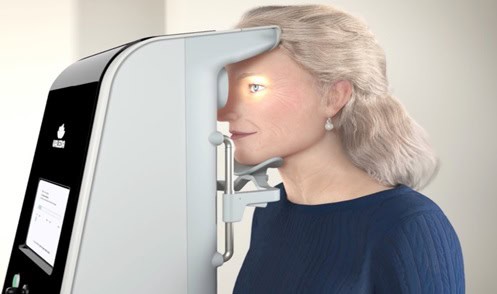
The Valeda system utilises advanced photobiomodulation technology to deliver carefully controlled wavelengths of light to the retina in a painless, non-invasive procedure. This specialised light therapy stimulates energy production within the retinal cells, enhancing their ability to repair and regenerate while reducing harmful inflammation.
By improving cellular metabolism, Valeda not only aims to preserve vision but also slows the progression of Dry Age-Related Macular Degeneration (Dry AMD). The treatment is designed to support the overall health of retinal cells, offering a promising approach for managing Dry AMD and maintaining visual function over time.

Photobiomodulation (PBM) for Dry Age-Related Macular Degeneration
Photobiomodulation (PBM) using the Valeda Light Delivery System is a non-invasive treatment for dry age-related macular degeneration (AMD). It uses selected wavelengths of light with the aim of influencing cellular function within remaining viable retinal tissue.
Current evidence
Clinical trials have reported modest improvements in visual function in some patients treated with PBM. The strongest evidence currently relates to patients with earlier/intermediate dry AMD and relatively well-preserved vision. More recent studies have also investigated whether PBM may reduce progression towards geographic atrophy (GA), although the evidence base remains relatively early and continues to evolve.
Earlier PBM studies included some patients with more advanced AMD and geographic atrophy, including foveal-involving GA and visual acuities as poor as approximately 20/200 (6/60). However, the better treatment responses were generally seen in patients with earlier disease. Subsequent larger trials therefore concentrated predominantly on patients with better-preserved retinal function and without established centre-involving GA.
Geographic atrophy and advanced disease
Geographic atrophy represents permanent loss of retinal tissue. PBM cannot regenerate retinal cells that have already been lost and should not be expected to restore central vision already lost as a result of established geographic atrophy.
Where PBM is considered in a patient with more advanced disease, the rationale is therefore not to restore already-lost retinal tissue. The potential aim is to support remaining viable retinal cells and possibly slow or stabilise further deterioration. Whether PBM achieves this in an individual patient with advanced GA is uncertain, and there may be no measurable benefit.
Patients with advanced or centre-involving GA, or substantially reduced visual acuity, should therefore understand that they fall outside the patient group in whom the strongest evidence of benefit has been demonstrated.
FDA indication and qualifying AMD features
The regulatory indications for Valeda differ between jurisdictions. The current US FDA indication is specifically for patients with best-corrected visual acuity of 20/32 to 20/70 and dry AMD characterised by:
- at least 3 medium drusen, greater than 63 µm and up to and including 125 µm in diameter; or
- large drusen, greater than 125 µm in diameter; or
- non-central geographic atrophy;
and requires the absence of neovascular maculopathy (“wet” AMD) and absence of centre-involving geographic atrophy.
The FDA states that after approximately two years, treated patients demonstrated an average improvement of approximately one ETDRS line compared with patients not receiving treatment.
The FDA also specifically notes that safety and effectiveness have not been established in populations excluded from the pivotal clinical study, including patients with centre-involving GA, and that evidence is limited for visual acuity worse than 20/70 or better than 20/32. These restrictions define the current US FDA-labelled population and should not automatically be interpreted as the regulatory indication applicable in the United Kingdom.
European and UK regulatory documentation has historically expressed the indication for PBM in dry AMD more broadly. Treatment recommendations in the UK are therefore made on an individual basis, taking account of the manufacturer’s current UK Instructions for Use, the available clinical evidence and the patient’s particular retinal findings.

What should I expect from treatment?
PBM should not be regarded as a cure for dry AMD, and improvement in vision cannot be guaranteed. Some patients may experience improvement or stabilisation of aspects of visual function, while others may notice no benefit.
In patients with established geographic atrophy, particularly when the central retina is already involved, maintenance or slowing of further deterioration rather than improvement in existing vision may be the principal therapeutic objective, and even this cannot currently be guaranteed.
Dry AMD remains a progressive condition. PBM does not eliminate the possibility of further geographic atrophy or development of neovascular (“wet”) AMD. Continued retinal monitoring therefore remains important.
Making a decision
Whether PBM is appropriate depends upon the stage and pattern of AMD, visual acuity, OCT and other retinal imaging, the amount of remaining viable retinal tissue, and the individual’s circumstances and expectations.
Patients with earlier disease are generally more likely to fall within the populations in which benefit has been demonstrated. In more advanced disease, treatment may sometimes be considered following an individual discussion, but the uncertainty regarding benefit is greater.
The potential benefits, limitations, uncertainties, alternatives and the possible implications for future clinical-trial participation will be discussed before treatment. Choosing to undergo PBM should be based on an understanding that benefit cannot be guaranteed and that established retinal tissue loss cannot be reversed.
Research into dry AMD is developing rapidly, and other treatments may become available in the future. Recommendations may therefore change as further evidence and treatment options emerge.
Future clinical trials and other treatments
Research into dry AMD and geographic atrophy is developing rapidly, and new treatments and clinical trials may become available.
Previous treatment with photobiomodulation could affect eligibility for some future clinical trials. Individual studies have their own inclusion and exclusion criteria, which may exclude previous experimental or investigational treatments, impose a specified treatment-free period, or require participants to meet particular anatomical or visual-acuity criteria.
PBM treatment does not mean that a patient will necessarily be excluded from future research or treatment, but future trial eligibility cannot be guaranteed. Patients who are particularly interested in participating in clinical trials should discuss this before starting PBM so that currently available or anticipated studies can be considered where appropriate.
Benefits of Valeda Therapy
Non-Invasive:
The procedure is completely painless and does not require surgery or injections.
Quick Treatment:
Each session lasts only a few minutes, making it a convenient option.
Slows Disease Progression:
Helps maintain vision by targeting early-stage Dry AMD before significant damage occurs.
Initial Trial Evidence:
The initial trial evidence of Valeda therapy has been encouraging.
Treatment Process
Valeda therapy is delivered over several sessions, typically completed within a few weeks. Patients sit comfortably while a specialised light is directed into the eyes. There is no downtime required, allowing individuals to resume daily activities immediately after treatment.

Using Targeted Wavelengths
The Valeda system utilises three targeted wavelengths of light—590 nm, 660 nm, and 850 nm—each playing a distinct role in promoting retinal cell health:
590 nm:
Reduces vascular endothelial growth factor (VEGF) expression, helping to minimise abnormal blood vessel growth, and aids in the removal of cellular deposits.
660nm:
Enhances oxygen binding and stimulates the production of adenosine triphosphate (ATP), which helps to reduce inflammation and prevent cellular loss.
850 nm:
Boosts metabolic activity and ATP production, reduces inflammation and cellular loss, and facilitates electron transfer to support cell function.

Why Choose The Forbury Clinic?
Choosing The Forbury Clinic for Valeda Photobiomodulation Therapy means accessing expert care from experienced ophthalmologists who specialise in advanced retinal treatments. We use the latest Valeda technology to deliver safe, non-invasive therapy that targets early stage Dry AMD effectively. Our patient focused approach ensures personalised care tailored to your specific needs, prioritising your comfort and helping to protect your vision for the future.